

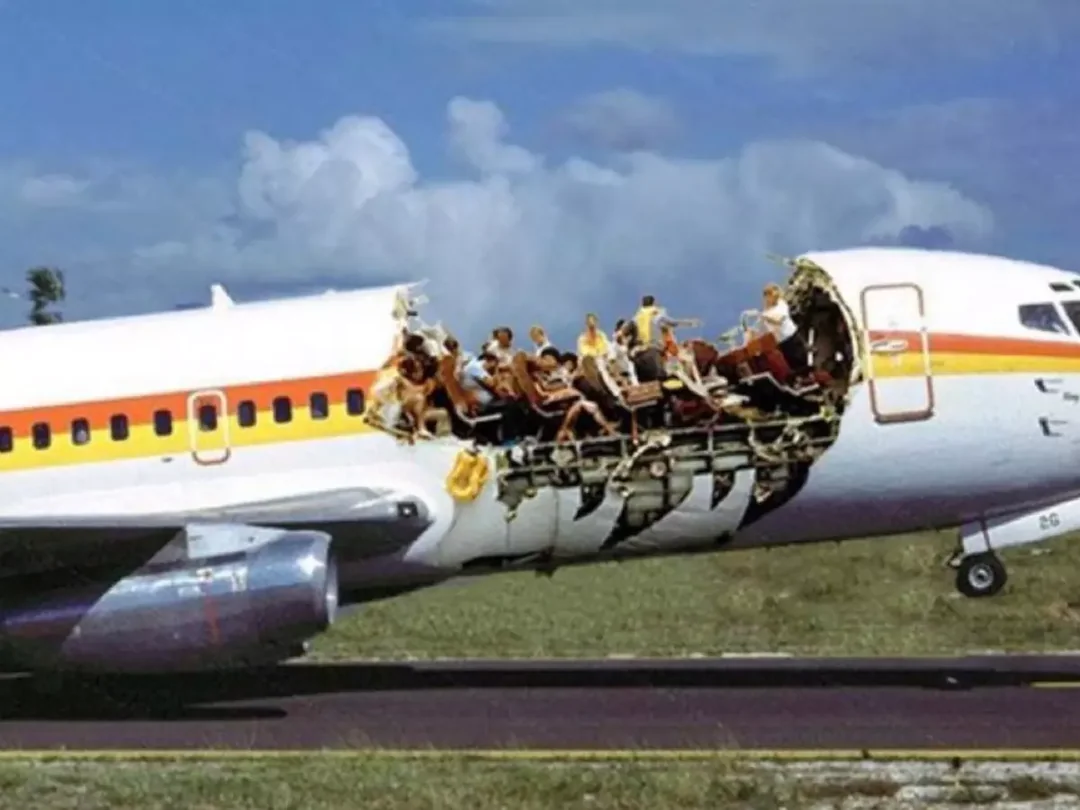

What Happened on Aloha Airlines Flight 243?
On April 28, 1988, Aloha Airlines Flight 243 became the most shocking metal fatigue failure in aviation history. A Boeing 737 fuselage tore open at 24,000 feet over Hawaii — not because of a bomb or pilot error, but because of cumulative fatigue damage that had been silently building for 89,680 flight cycles. This is the story of how fatigue failure turned a routine 35-minute island hop into a fight for survival.
This flight was actually travelling from Hilo to Honolulu. Hilo is the southernmost island of Hawaii. It was a routine flight, a 35-minute flight only. The Aloha Airlines was a local Hawaiian airline which connected the various islands. Because of the short distances, this specific plane had already flown 8 times since morning. But this wasn’t unusual, It’s normal for such planes.
Everything was going as it should. Passengers board, the doors were closed, and at exactly 1:25 PM, the flight took off.
There was one unusual thing though, when one of the passengers was boarding the plane, before entering the door, she saw that the riveted sheets that made the body of the plane, one of those sheets had a small crack, but she didn’t tell anyone about it thinking that it wouldn’t make a difference, since this was a reputable airline, and the plane typically flew regularly.
Assuming that it was inspected regularly. And that someone would have noticed if there were any problems. She thought that it was inconsequential. But no one could have imagined how devastating this was going to be.
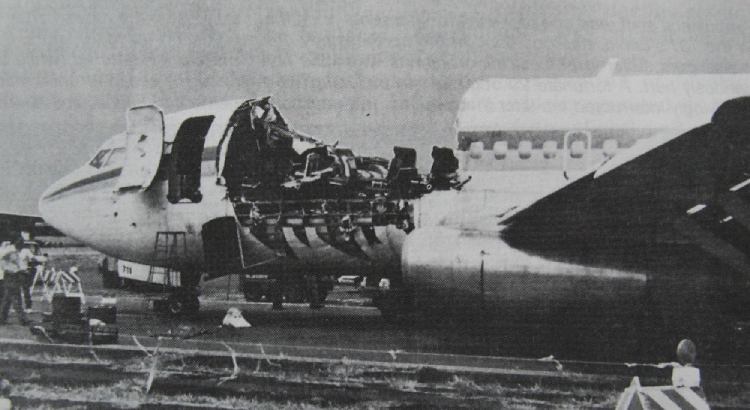
Why Did the Aircraft Structure Fail?
Only after 10-15 minutes of the plane’s take-off, the flight attendants brought in the trolleys and started serving drinks to the passengers. The seat belt sign wasn’t turned off yet, because it was usually turned off only when the plane reached cruising altitude. And for this plane, the cruising altitude was 24,000 feet.
There were three flight attendants on the flight, serving drinks to the passengers. And just 20 minutes after the take off, the flight reached its cruising altitude of 24,000 feet. And as soon as it reached this height, there was a huge blast.
The passengers heard a loud bang and there was a sudden rapid decompression. People had trouble breathing. Things went flying all around.
Total chaos and terrible confusion. No one could understand what was happening. Some passengers looked around and saw that the plane’s roof and surrounding walls were missing. They could see the sky above them.
What happened was that about 35 m² (square meter) of the front of the plane’s body had disintegrated and blown away. What usually happens is that the air is always pressurized in cabins in a plane.
So that we can breathe normally. Otherwise, at a height of 24,000 feet, the atmospheric pressure is very low, the air is so thin that we cannot breathe normally at that height.
That is why aeroplanes have their own pressurization system which regulates the air by pumping it. If for some reason this system breaks down and the aeroplane keeps flying at the same altitude then in case of this emergency, those oxygen masks will drop down.
You must have heard about this in the safety briefings, “In the event of loss of cabin pressure, oxygen masks will drop.” These oxygen masks, typically contain an oxygen supply for about 15-20 minutes, during which time the pilot has to get the plane to descend to an altitude where people can breathe normally, At a height below 10,000 feet.
Now, in this story, what happened in Flight 243 was that, the oxygen masks did drop, but the oxygen mask system was not working.
Due to the plane’s roof being blown away, the oxygen mask system was completely destroyed. People were concerned about hypoxia.
The condition in which if your body does not get sufficient oxygen you might become unconscious and eventually, lose your life. Within seconds, people started feeling dizzy. In such cases, it took only 1-2 minutes to lose consciousness.
Michelle Honda, a flight attendant, was near Row 15 during the explosion. She tried contacting the cockpit through the intercom. But there was no response from the other side.
The second flight attendant, CB Lansing, was serving a drink to a passenger near Row 5. When the roof of the plane blew apart, she went flying out of the plane.
Their third colleague, Jane Sato, was near Row 2. She fell to the floor after being hit by some flying luggage, There was commotion all around.
When Michelle didn’t get any answer from the pilots, she went to each and every passenger to ask, if they knew how to fly a plane. This scared the passengers further.
They were being asked to fly the plane. This made them think about the pilots. Without trained pilots, they were doomed to crash.
She reached near the cockpit by crawling on the floor. There she saw her colleague Jane’s head was bleeding. When she tried to look inside the cockpit, she couldn’t see anything.
The cockpit’s view was completely blocked. There were only a few precious minutes after which all of them would lose consciousness and die. But apart from hypoxia, these passengers had to bear strong winds.
Winds as fast as nearly 500 km/h speed were blowing at them. It was difficult to keep their eyes open. And the temperature was at -45°C at this height. Even if there was oxygen supply somehow, it wasn’t possible to survive long in that cold. Because most of the passengers were wearing shorts and t-shirts.
Hawaii is a tropical place where people go to see beaches and jungles. There is no snow here, So no passenger was prepared for this temperature.
Michelle was the only flight attendant in her senses. She kept trying to contact the pilots. “Can anyone hear me?” But there was no answer.
Among all these dangers, the good news was that the pilots were actually alive. And not just alive, the pilots were in much better condition than the passengers. Their oxygen masks were thankfully working.
44-year-old Captain Robert Schornstheimer was in command, A highly experienced pilot working for Aloha Airlines for 11 years. With him was the 36-year-old First Officer, Mimi Tompkins.
When the explosion happened, both of them felt the shock, And when they turned around to see, they saw that the plane’s roof was missing as well as the cockpit door. There was debris all around, but both of them immediately got to work.
First of all, they wore their oxygen masks and considering the situation, they decided to go for an emergency descend, they descended 4,100 feet at the speed of 500 km/h. But the time constraint wasn’t only for the descent of the plane.
They had to face another problem, bigger than this. It was found that due to this incident, the nose of the plane, the front part in which they were sitting, was drooping down a bit, only by about 1 metre.
The floor of the plane was the only thing holding the cockpit and cabin together. If they kept flying thus for a long time, the two parts might break apart.
Mimi Tompkins contacted Honolulu and informed them about their situation. They were told to land the plane in Maui instead of Honolulu, since it was closer.
At 1:48 PM, she contacted Maui tower and informed them about the situation. It was about 3 minutes since the plane’s roof had flown away.
But thankfully, the plane was at 14,000 feet. At this height, it wasn’t difficult for most passengers to breathe. And since it had descended within 3 minutes, most people didn’t lose their consciousness and at least the risk of hypoxia was over.
Mimi Tompkins contacted Maui Airport and told them to keep all emergency services ready. Anything could happen. Firefighters and rescue vehicles were at standby on the runway.
Everyone was waiting for this plane to land. A minute later, the plane had reached the height of 10,000 feet, when another problem arose. There was a 10,000-foot mountain in front of them, The Haleakala Summit.
This mountain was between the plane and Maui airport. Captain Robert slowed down the plane. 210 knots, 200 knots, 170 knots. They kept slowing down. They flew it as slowly as possible.
Any slower and it would be difficult to control the flight. Maintaining this speed of 170 knots, they navigated the plane between two islands. The plane evaded the mountain and turned towards the airport.
As the plane went towards the runway, Mimi Tompkins deployed the landing gear. There should be 3 sets of wheels, 2 on the rear and 1 on the front.
The ones at the rear were called the main gear, the indicator showed that the main gear was successfully released. But the nose gear, the wheels at the front, weren’t releasing properly. Now, technically speaking, it is possible to land without the front wheels, the nose gear.
This is known as ‘Belly Landing’. And it is done during emergency cases. But in this specific case, where the middle portion of the plane was so weak, and the roof was already missing. The pilots were afraid to attempt a belly landing because then the plane would crash definitely. And if something happened to the fuel tank there could even be a blast.
This airplane, and the condition it was in, because it didn’t have a nose gear, because when the nose touched down on the runway, it would’ve broken the airplane apart, therefore, breaking perhaps the fuel tanks apart.
Which could lead to a very dramatic fire and explosion. But there was no other option there was nothing else they could do. The pilots decided to attempt landing like that.
As soon as the runway was visible the passengers were holding on for the landing. Some started praying. Others were hugging the people around them. This could very well be the last time they saw each other. Most of the passengers were still terribly scared.
As the plane descended, it had started moving side to side. The pilots realized that their left engine had failed. They tried to manually restart the engine, but unfortunately, they couldn’t restart it.
By this time, the emergency services were prepared on the runway. Firefighters, ambulances, evacuation teams everyone was preparing for the worst situation. Trying to minimize the damage.
At 1:56 PM, the pilots informed the Maui Tower, that they would need all the equipment the airport had. Meanwhile, a person on the runway was tracking the plane with binoculars.
That’s when he spotted, that the nose gear was successfully released. The plane didn’t need belly landing. They informed the pilots, One less thing for the pilots to worry about.
Then, at 1:58 PM, exactly 13 minutes and 42 seconds after the explosion, Aloha Airlines Flight 243 touched down on the runway.
Apart from using the brakes, the captains used the thrust reversers of the remaining engine. Gradually, the plane came to a halt safely. The emergency teams present on the runway breathed a sigh of relief.
The passengers were deboarded from the plane through the emergency exit. The passengers applaud the captain and thanked him for saving their lives.
Although most of them were safe, many of them were seriously injured. An 84-year-old female passenger who was sitting on seat 5A had a skull fracture and suffered the most injuries.
The passenger sitting in 6A suffered a broken hand. The passengers in 4A and 4F were seriously injured. Basically, most of the passengers in Rows 4 to 7 were seriously injured.
Because the roof of this area had blown apart. And the passengers in Rows 8 to 21 were only minorly injured. Apart from this, there were 21 passengers who weren’t injured at all.
Flight attendant Jane Sato remained unconscious she suffered only a concussion. Flight attendant Michelle Honda was safe and after landing she counted the number of passengers to check whether any of them were missing. And it turned out that miraculously, everyone was safe and alive except for one.
58-year-old flight attendant C.B. Lansing was the only one who passed away in this incident. Search teams tried to find her later, but unfortunately, her body couldn’t be found. She disappeared into the depths of the sea forever. And the remaining 94 people were grateful to have survived.
Was it mere luck that they survived? No. The credit goes to the technical equipment called ‘seat belt’, the main reason why so many people could survive.
As you’ve read in the beginning, because this flight hadn’t reached cruising altitude, the seatbelt sign was still on and people were wearing their seatbelts. Had those people sitting in Rows 4 to 8 not worn their seatbelts, they too would have flown out of the plane.
After this incident, as this news spread, the photos of this plane were published in newspapers globally. A miracle flight without a roof. After this, America’s National Transportation Safety Board sent a team of investigators to investigate this incident. To find the cause of this incident.
The Role of Metal Fatigue in Aircraft Cracks
The investigation team found that this plane had completed 89,680 flight cycles and 35,496 flight hours. The fuselage of this plane, the main body of the plane, was weakened due to fatigue and corrosion.
Whenever the plane was in the air, the metal sheets on it expanded due to the pressurized cabin. And when it was on the ground, the fuselage contracted. This constant cycle of expansion and contraction made it weak.
This was a Boeing 737 plane whose fuselage is made of aluminium sheet metal panels arranged circumferentially in a frame. Each panel overlaps each other by 3 inches. And the overlapping area is called the Lap Joint.
Because the thickness of these sheets was only 1 mm, Boeing developed a bonding process to allow the skin to absorb stress like a single unit.
The company used a strong glue called Epoxy to join the different parts of the plane. When this glue dried, a strong bond developed to distribute the stress in all the plates and to prevent any cracks. Glue wasn’t the only way to keep these sheets together. In addition to the strong bond of glue, there were three rows of rivets on every overlap. The overlapping parts of every sheet were riveted together so that the entire frame of the aeroplane could be secured.
Boeing’s first batch of 737 aeroplanes used this method to join the sheets. But later on, problems arose due to using this method. They found that when the moisture content in the air was high, the bonds became weaker. The epoxy glue started degrading and the metal started corroding.
This meant that the stress on these sheets was borne by the rivets instead of the glue. Because of this problem, in 1972, Boeing decided to use a new method of attaching these sheets together. They started using Hot Bonding, It uses heat and pressure to attach two sheets together.
Interestingly this hot bonding system was already being used since 1972. And the Aloha Airlines Flight 243 incident happened 16 years later.
So, this airline was blamed for still using the old aeroplane. Boeing had issued a service bulletin in 1972 stating the issue with their planes and possible problems it might cause. In fact, in 1987, one year before this incident, Boeing issued an Alert Service Bulletin that their older planes should be inspected and repaired properly in case any airline was still using them.
Apart from this, Boeing had a Safety Design stating that in case of a tear in the fuselage, it needed to be limited to a 10 inch by 10 inch square.
They had placed Tear Straps at every 25 cm of the plane’s body. So that even if any part of the plane’s body tore, the tear wouldn’t spread to the rest of the body. But the Flight 243’s condition was so terrible, that there were numerous cracks across it. So many cracks that these tear straps weren’t really useful.
The NTSB said that when this flight reached its cruising altitude, the pressure exerted reached its peak because of which the individual cracks came together and the entire section of the roof blew apart. NTSB’s final report listed three main reasons for this incident.
First, management at Aloha Airlines failed to supervise the maintenance program properly and failed to assess the inspections and quality controls properly.
Secondly, they blamed the US Federal Aviation Administration to some extent for not requiring a thorough thorough inspection of the joints while issuing the Airworthiness Directive.
Whereas Boeing had recommended this. However, the FAA had definitely told Aloha Airlines to use a new testing method to find cracks in the plane’s body. The Eddy Currents technique. In it, electric current is passed through metal to detect even the smallest of cracks which aren’t even visible to human eyes.
Aloha Airlines claimed that they did use this technique to find cracks but they were later found to be lying, they hadn’t inspected their planes properly.
Third, when it was discovered that there were problems with the old bonding technique both Boeing and FAA took these issues lightly. Boeing had designed its 737 plane to fly for 20 years.
With the set time limit at 51,000 flight hours and 75,000 cycles. Even though the total flight hours of Flight 243 was lower than this, this plane was used for short distance flights. Because of this, its flight cycle count was at 90,000. Whereas Boeing had recommended a service life of only 75,000 cycles.
How Pressurization Cycles Caused Structural Damage
Each flight created one complete pressurization cycle inside the fuselage. Over thousands of cycles, microscopic cracks formed near riveted joints and window corners due to stress concentration. These cracks slowly propagated through the aluminium skin until catastrophic structural failure occurred.
The plane was near the end of its 20 year life, which was another reason for this incident. A positive outcome of this incident was that all of Boeing’s older aeroplanes were inspected again. And do you know what they found? Many of them had cracks. Similar to the cracks in Flight 243.
This proved that this problem wasn’t limited to this plane. Other planes of this fleet had the same problem.
Another positive outcome was that ever since this incident, safety regulations are made stricter all over the world to prevent such accidents from happening ever again.
In 1991, the Federal Aviation Authority launched its Aging Aircraft Safety Program. As per this Program, all old aircraft will need to undergo mandatory inspections and control programs. After this, the techniques used in aircraft maintenance to detect cracks have also been changed forever.
Engineering Lessons from Flight 243
Using Eddy Current, ultrasonic testing, methods that don’t rely on human eyes, are now used to detect such cracks early on. New rules were made for high-cycle planes. Like the Aloha Airlines flights, there are other short duration trips, where the planes have to complete as many as 10-20 flights a day.
They are now required to be inspected more frequently. The American government passed a new law. The Aviation Safety Research Act, 1988. To better understand and plan for the structures and issues of ageing aircraft. Overall, this one incident, changed the aviation safety standards forever.
Fatigue Life Calculation and Cumulative Damage Assessment
This disaster highlighted a critical rule in structural life prediction: you cannot evaluate safety based on static ultimate strength alone. A structure must be analyzed using cumulative damage models over its entire stress history.
In real-world environments, components rarely face constant loading. To prevent failures like Aloha Flight 243, modern structural engineers capture complex load histories and perform sequential analysis:
-
Cycle Counting: Raw stress data from sensors is processed using algorithms like Rainflow Cycle Counting to extract individual stress loops.
-
S-N Evaluation: Each extracted cycle is matched against the material’s specific S-N curve to find its partial damage factor.
-
Life Prediction: Using Miner’s Rule, the cumulative damage is summed up to calculate the exact remaining service life before crack initiation.
From Manual Fatigue Analysis to Automated Prediction
Manually processing thousands of variable flight cycles against complex S-N curve equations is highly inefficient and prone to mathematical errors.
To streamline your structural integrity workflow, you can use The FatigueLab Detailed Fatigue Calculator. Our tool allows you to upload raw stress history CSV data directly.
It automates the entire process—performing instant Rainflow cycle counting, evaluating material S-N curves, and executing a precise cumulative damage assessment to predict fatigue life in seconds, ensuring your designs never reach their breaking point.
Safety Margins, Fail-Safe Design, and Structural Failure Limits
To provide a fail-safe mechanism, Boeing had incorporated a safety design intended to limit any localized fuselage tearing to a controlled 10-inch by 10-inch square. They placed titanium “Tear Straps” every 25 cm along the plane’s body to arrest crack propagation.
But Flight 243’s condition was so critical that multiple rivet holes had developed cracks simultaneously. When the flight reached its cruising altitude of 24,000 feet and the cabin differential pressure peaked, these individual micro-cracks linked up instantaneously.
This widespread fatigue damage bypassed the tear straps entirely, causing a massive section of the roof to unwrap instantly