


1. What Is Miner’s Rule?
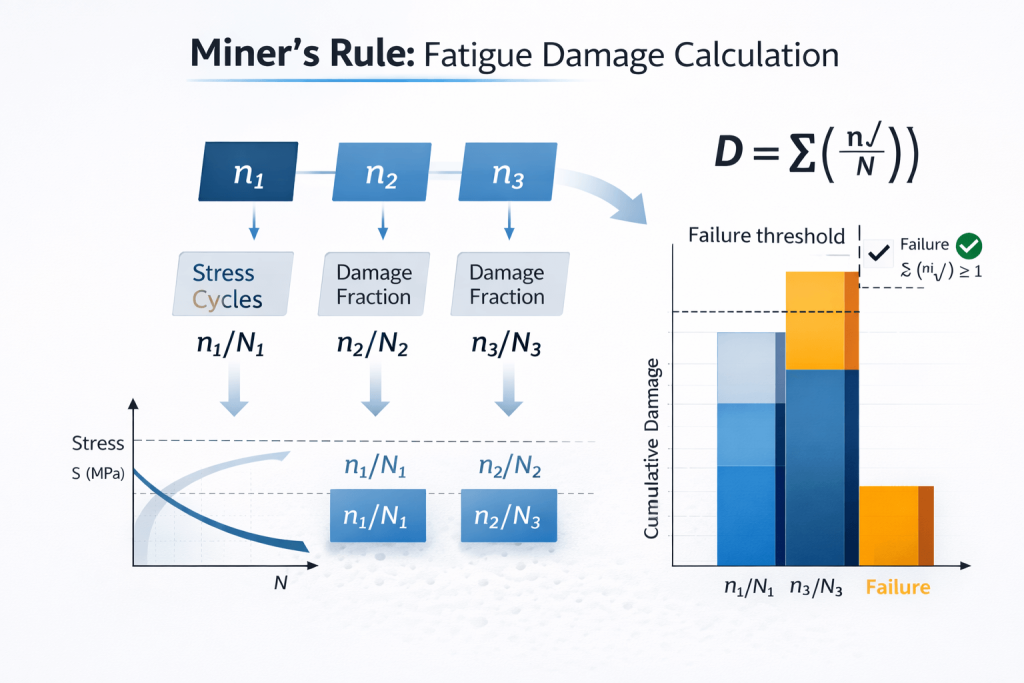
Miner’s Rule is a mathematical model used to estimate cumulative fatigue damage caused by repeated loading cycles.
The rule assumes that each stress cycle contributes a small fraction of damage to the material. When the total
accumulated damage reaches a critical value, the component is expected to fail.
This approach allows engineers to evaluate fatigue life when a component experiences multiple stress levels over time.
2. The Miner’s Rule Equation
The basic Miner’s Rule formula is:
D = Σ (ni / Ni)
Where:
- D = total accumulated fatigue damage
- ni = number of applied cycles at a specific stress level
- Ni = number of cycles to failure at that stress level from the S–N curve
Failure is expected when the total damage value reaches approximately:
D = 1
3. Concept of Damage Fraction
Each stress cycle contributes a fraction of fatigue damage. For example, if a component can survive
100,000 cycles at a given stress level but experiences 10,000 cycles, then the damage contribution is:
Damage = 10,000 / 100,000 = 0.1
This means that 10% of the fatigue life has been consumed at that stress level.
4. Example of Miner’s Rule Calculation
Consider a component experiencing two different stress levels during operation:
| Stress Level | Cycles Applied | Cycles to Failure |
|---|---|---|
| High Stress | 10,000 | 100,000 |
| Medium Stress | 20,000 | 200,000 |
Applying Miner’s Rule:
D = (10,000 / 100,000) + (20,000 / 200,000)
D = 0.1 + 0.1 = 0.2
This means that 20% of the fatigue life has been consumed.
5. Miner’s Rule in Variable Amplitude Loading
In real engineering systems, loads are rarely constant. Instead, components experience variable amplitude loading
where stress levels continuously change. To analyze such conditions, engineers first apply rainflow cycle counting
to extract stress cycles from a load history.
Once the cycles are extracted, Miner’s Rule is used to calculate cumulative fatigue damage.
6. Advantages of Miner’s Rule
- Simple and easy to apply
- Compatible with S–N fatigue curves
- Works well with rainflow cycle counting
- Widely used in fatigue engineering and durability testing
7. Limitations of Miner’s Rule
- Assumes linear damage accumulation
- Ignores load sequence effects
- Does not account for crack growth behavior
- May underestimate damage under certain loading conditions
Despite these limitations, Miner’s Rule remains one of the most widely used fatigue damage models due to its simplicity.
8. Calculating Fatigue Damage Using FatigueLab
You can estimate cumulative fatigue damage using the FatigueLab fatigue damage calculator
The calculator automatically performs rainflow cycle counting, applies S–N curve parameters, and calculates
fatigue damage using Miner’s Rule.
9. Summary
Miner’s Rule provides a simple yet powerful method for estimating cumulative fatigue damage. By summing the
damage fractions from different stress cycles, engineers can estimate how much fatigue life has been consumed
and predict when a component may fail.