


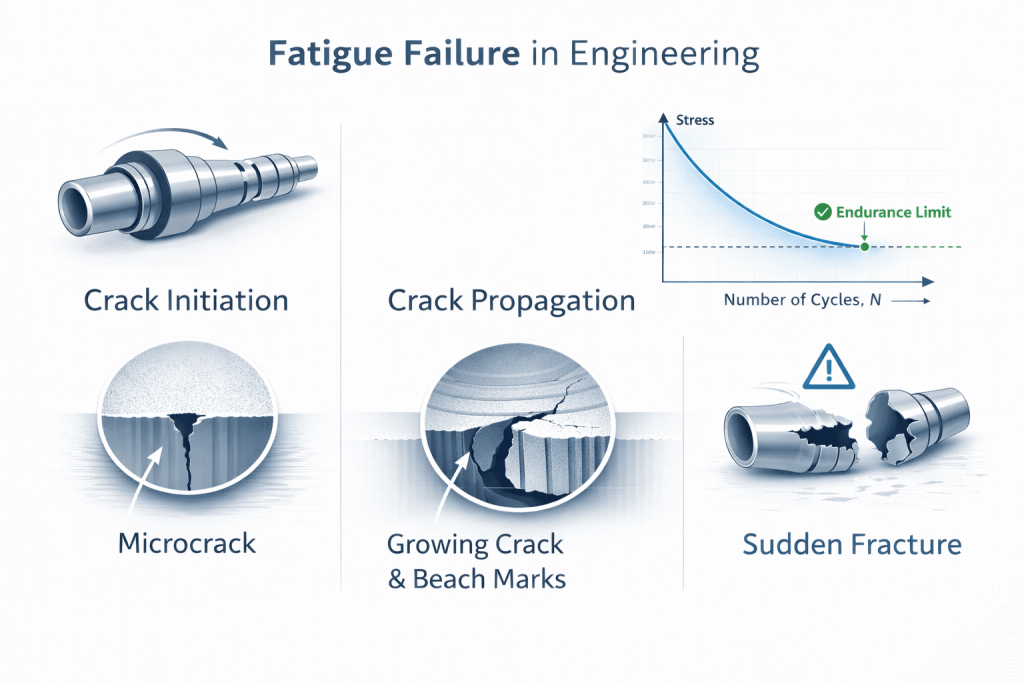
Unlike overload failures, fatigue is slow, progressive and usually invisible until the final sudden fracture.
1. What Is Fatigue Failure?
Fatigue failure is a type of mechanical failure caused by cyclic loading. When a component experiences repeated stress
cycles, microscopic cracks begin to form. These cracks grow with each cycle until the component finally fractures.
Fatigue failure accounts for nearly 90% of all metallic structural failures.
2. Why Fatigue Happens (The Science Behind It)
- Stress cycles introduce micro-cracks at weak points, surface scratches or inclusions.
- Crack grows slowly with every loading cycle (stable crack growth).
- Final fracture occurs suddenly once the remaining cross-section cannot withstand load.
3. Key Terms You Must Know
• Stress Amplitude (σₐ)
Half of the stress range in a cycle. Controls crack growth rate.
• Mean Stress (σₘ)
Average stress around which the stress fluctuates. Affects fatigue life significantly.
• S–N Curve
Graph showing stress amplitude vs number of cycles to failure.
Used to estimate fatigue life using Basquin’s law.
4. Stages of Fatigue Failure
1) Crack Initiation
Starts at sharp corners, keyways, weld defects, surface scratches or stress concentrations.
2) Crack Propagation
Crack slowly grows; “beach marks” appear on fracture surface.
3) Final Fracture
Sudden catastrophic break when remaining area can no longer carry load.
5. Real Engineering Examples
- Aircraft wings experiencing millions of flex cycles.
- Rotating shafts in pumps, turbines and motors.
- Automotive suspension components under repeated road loads.
- Bolts & fasteners subjected to fluctuating tension.
- Bridges due to traffic and wind loading.
6. How to Predict Fatigue Failure
Fatigue life can be estimated using S–N curves, Basquin parameters, mean stress correction models (Goodman, Soderberg)
and cumulative damage methods like Miner’s Rule.
You can estimate fatigue damage and life using the
FatigueLab Detailed Damage Calculator.
7. How to Prevent Fatigue Failure
- Reduce stress concentrations (use fillets, rounded edges).
- Use better surface finish (polishing increases fatigue life).
- Apply compressive residual stresses (shot peening).
- Increase material thickness in critical regions.
- Use materials with higher endurance limits.
- Apply suitable safety factors.
8. Summary
Fatigue failure is a slow yet dangerous process that occurs due to repeated stress cycles. Understanding S–N curves,
stress amplitudes and crack propagation helps engineers design safer components and predict failure more accurately.