


Understanding the Different Ways Forces Act on a Material or Component
In mechanical and structural engineering, loading conditions determine how forces interact with a component.
These loads influence stress distribution, deformation, fatigue life, and safety margins. Understanding them is
essential before performing design calculations, simulations, or fatigue analysis (such as using the tools at
FatigueLab.pro).
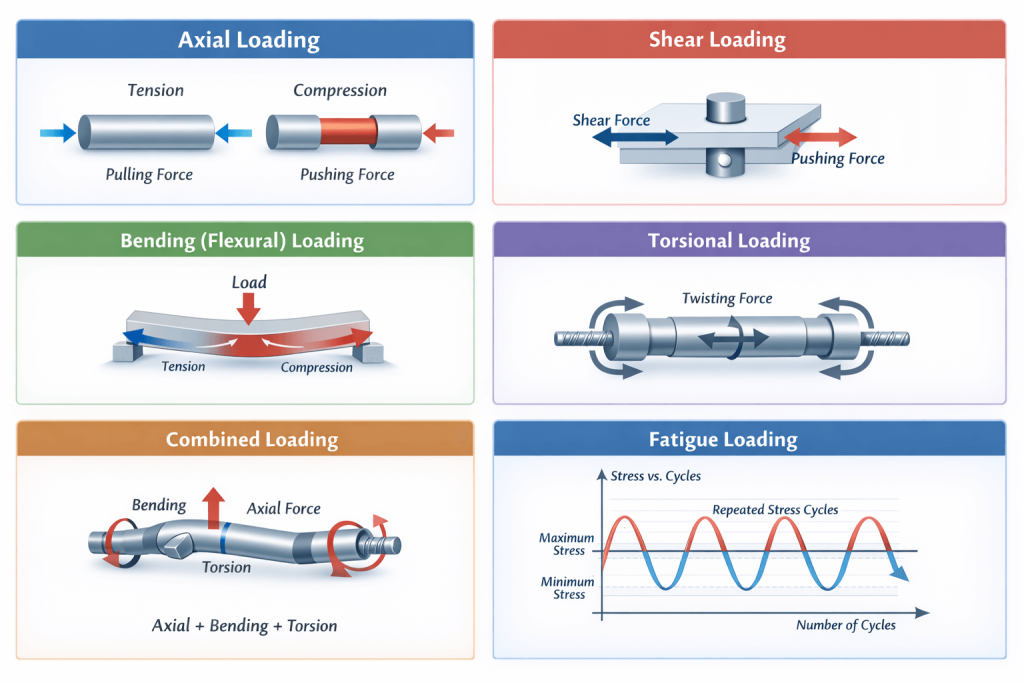
1. Axial Loading
Axial loading occurs when a force is applied along the axis of a component. The stresses produced are uniform
across the cross-section. It may be:
- Tensile (pulling)
- Compressive (pushing)
2. Shear Loading
Shear loading occurs when opposing forces act parallel to the surface of a material. Shear is commonly seen in:
- Rivets and bolts
- Joining plates
- Beams under transverse loads
3. Bending (Flexural) Loading
Bending loads create tension on one side of a beam and compression on the other side. This is the most common
loading condition in beams, shafts, and structural frames.
4. Torsional Loading
Torsion occurs when a component is twisted around its axis. Shafts that transmit power (such as in engines or
turbines) commonly experience torsional loads.
5. Combined Loading
Real components rarely experience only one type of load. In practice, forces combine to create multiple stresses
simultaneously. Examples include:
- Bending + Torsion in drive shafts
- Axial + Shear in bolts
- Bending + Shear in beams
6. Loading Conditions in Fatigue Analysis
When analyzing fatigue, the type of loading condition directly affects stress amplitude and number of stress cycles.
Repeated bending, torsion, and combined loading significantly accelerate fatigue damage. You can evaluate this in
detail using the
FatigueLab Damage Calculator.
7. Summary
Understanding loading conditions is the first step in analyzing stresses, designing safe components, and predicting
fatigue life. Whether a part is in axial, shear, bending, torsion, or combined loading, each condition produces
unique stress patterns that must be evaluated properly. For further theory and fatigue concepts, explore the
FatigueLab Documentation.